How can you bring evaluation into a new project when you’re not even sure what your full strategy will be or what outcomes and impacts are possible?
And why would you want to?
Many nonprofit organizations and grant makers grapple with how to address long-standing, complex issues facing communities and the people they serve.

They’re thinking of the interrelated moving pieces, partners, and systems that need to come together for real change to happen.
Or they’re talking with others addressing the same issues in different ways and figuring out how the sum of their efforts could do more than each of them working alone.
They’re not sure what their goals and outcomes should be yet, because they need to co-develop them, and the way they think about the issue will come into focus and shift over time.
That’s where Developmental Evaluation—sometimes called Emergent Evaluation—comes in.
It’s a partnership between nonprofits or grant makers and an evaluator as they investigate, plan, try, learn, revise, and repeat.
A Developmental Evaluation Cycle
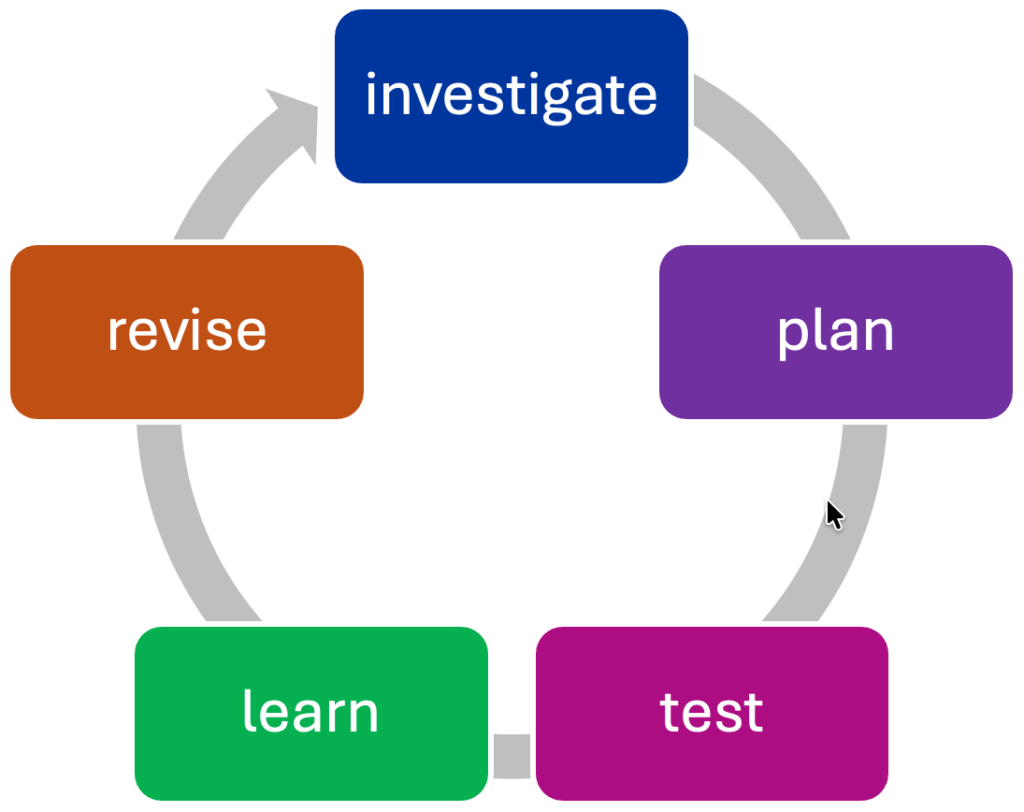
This partnership and ability to bring an evaluation lens to reflect, record decisions, and support the innovation process is Developmental Evaluation’s purpose.
The term “Developmental Evaluation” was coined in the 1990s by evaluation leader and innovator, Michael Quinn Patton and has since been advanced by many practitioners and scholars. It describes the role of an evaluator who is supporting work that prioritizes learning, collaborative design, and adaptation over pre-set frameworks and success metrics.
A Developmental Evaluator:
- Helps track key decisions and what they lead to,
- Lifts up themes in a client’s strategy planning meetings,
- Recommends questions to consider that will support forward momentum and, when it’s time,
- Articulates what the client and other key actors believe progress toward addressing their issue will look like.
Here’s an example:
A funder may bring together grassroots organizations working in diverse communities to address intergenerational poverty. A developmental evaluator joins planning meetings, contributes to agendas and facilitation during larger group meetings, records the group’s growing understanding about the issue, and provides regular documentation about decisions the group makes and approaches they test—which might include policy advocacy, community organizing, school-based programs, and services for individuals.
This helps the group—and the funder—decide on next steps and build momentum for promising actions. Later, as strategies and outcomes are defined, the evaluator can shift into a process or impact evaluation role, helping establish milestones and systems to measure change over time.
Developmental evaluation brings thought partnership and real-time learning and reflection support as new initiatives evolve from ideas to implementation.
As Developmental Evaluation practitioners, Radiance brings decades of experience to support innovators who are putting far-reaching plans into action in the nonprofit and funding sectors. I always find it to be a unique privilege to reflect a new insight back to a group of visionary folks that actually helps them take the next step together to make their bold, new ideas concrete.
Want to learn more?
Here’s a resource to check out.
If you’re building something new and finding that your strategy, partnerships, or definition of success are still evolving, developmental evaluation may be a good fit.
Interested in learning how Developmental Evaluation can support your innovative work? Fill out the Contact Us form on our website , or email me at robin@radianceforchange.com to set up a free call to explore more.